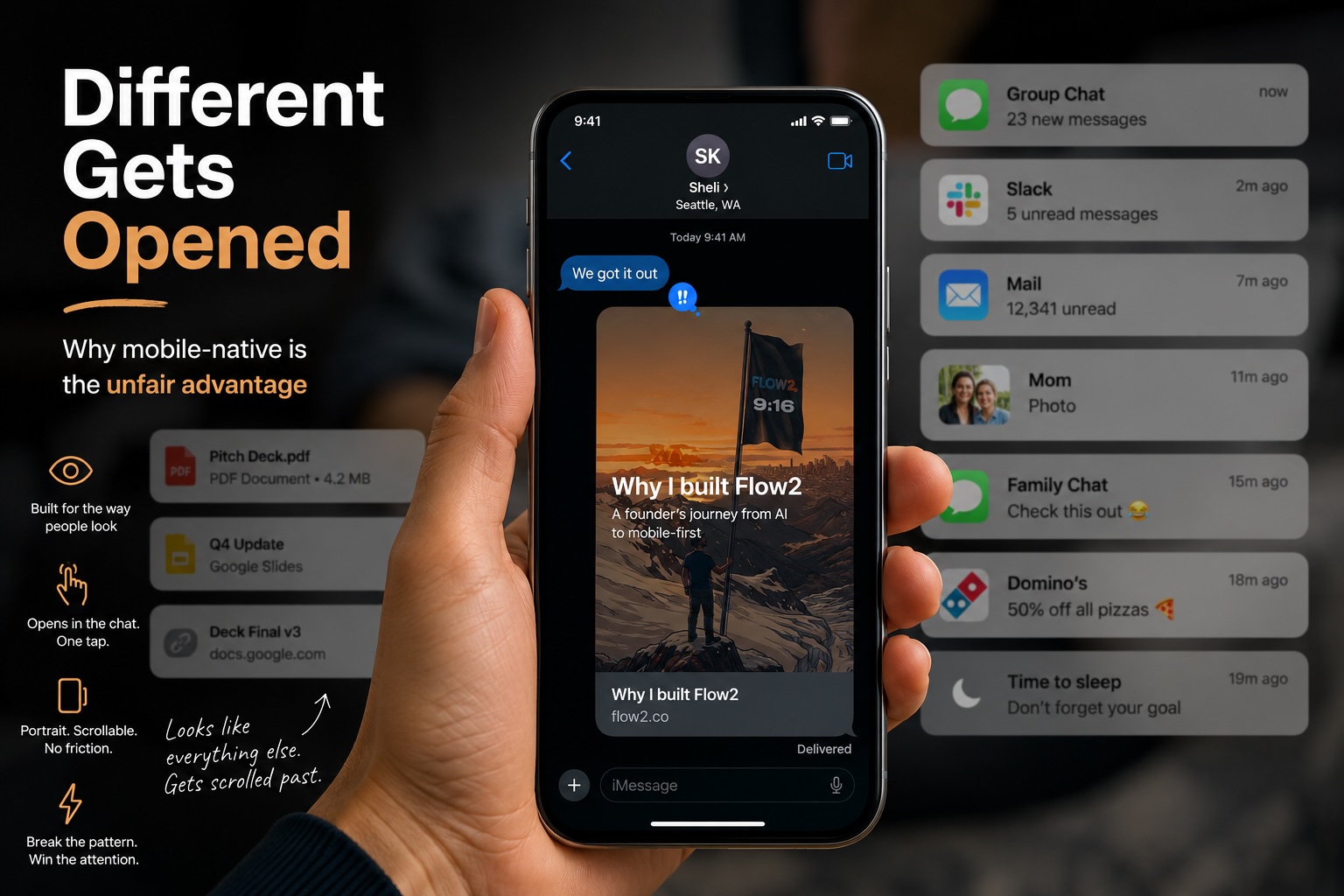
Why mobile-native is the unfair advantage
Your deck isn't competing with other decks. It's competing with everything else on the phone.
It is competing with the group chat. With Slack pings. With the unread email count. With the photo a cousin just sent. With the link a friend dropped in the family thread. With sleep.
In that fight, content does not decide anything. Format does. Content lives behind the tap. The tap only happens if the thing looks worth tapping.
A landscape PDF preview in iMessage looks like every other landscape PDF preview. A Google Slides link looks like every other Google Slides link. They get scrolled past. They get I'll look at it later. They get never opened.
That is the actual loss. Not a bad pitch. Not a weak narrative. An unread message. The deck you spent six hours on, sitting unread next to a Domino's coupon.
The move is not to make a better deck. The move is to not send a deck.
Send something that looks built for the device it landed on. Portrait. Scrollable. Opens in the chat with one tap. No login, no download, no pinch-to-zoom. Designed by someone who knew the recipient was on a phone. Because they are. Always.
That break in the pattern is the entire pitch. Before the first word, before the first slide, before the first image, the recipient has already decided whether to give you the next five minutes. The format made that decision.
This is uncomfortable if you have spent a career on the substance of decks. You want to think the words matter most. The words do matter. The words do not matter if the wrapper buries them.
Look at what already worked. The first mobile-optimized websites took share from desktop sites that looked broken on a phone. Vertical video took share from landscape video that showed up letterboxed. Responsive email got opened by people who used to delete. Every time a medium moved to the phone, the players who moved first won, and the players who shrank their old format lost.
Presentations are in that moment now.
Pitch decks. Sales decks. Investor updates. School projects. Real estate one-pagers. Internal memos. They are arriving on phones. Almost all of them are arriving in the wrong shape. The one that arrives in the right shape gets noticed. Not because the content is better. Because the recipient's eye, trained on a decade of vertical scroll, recognizes it as native.
Mobile-native is not a feature. It is a tilt. It tilts the open rate. It tilts the read rate. It tilts the reply rate. Compounded over a quarter, it tilts everything.
Different gets opened. Same gets buried.
Stop competing with decks. Compete with the rest of the phone.
Brent Brookler is the founder of Flow2. He has been building for the mobile screen since WAP and J2ME, and has spent the last twelve years on presentation software.
Send something different.
Describe it. Get a link. Watch it actually get opened.